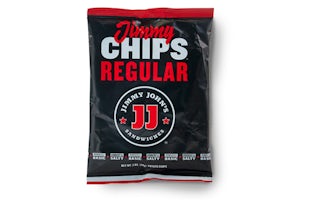
Regular Jimmy Chips have 300 calories per listed bag in our snapshot. The BBQ, Jalapeño and Salt & Vinegar entries each have 290. If you are choosing between those flavors for the same one-bag portion, the calorie difference is small. If you are deciding whether to add another bag, you are making a much larger change to the order.
That is the useful starting point for a chips comparison: confirm the unit, then the flavor, then the count. A calorie figure for a generic portion of potato chips may describe something different from the bag in your lunch. Here, the supplied serving is simply labeled “Bag.” The data does not give us a verified weight to attach to that label.
The four bag entries side by side
The flavors below are separate source items. Equal calories do not make the nutrition records identical. In particular, the three 290-calorie entries list different sodium amounts, so switching between them can leave the calorie total unchanged while changing another field in your meal.
| Chips, one listed bag | Calories | Total fat | Sodium |
|---|---|---|---|
| Regular | 300 | 18 g | 180 mg |
| BBQ | 290 | 16 g | 230 mg |
| Jalapeño | 290 | 17 g | 320 mg |
| Salt & Vinegar | 290 | 17 g | 360 mg |
All four entries list 3 grams of protein per bag. That matching figure is useful for adding up an order, but it should not distract from the different values in the other columns. A meal comparison becomes easier to interpret when you name the nutrient you are checking instead of describing one flavor as the overall winner.
The calorie gap between Regular and each of the other three flavors is 10. You may choose a flavor because you like it, and the table can simply tell you what that choice adds. There is no need to turn a small numerical difference into a claim about whether a particular flavor belongs in someone’s lunch.
One bag and two bags are different decisions
Two regular bags total 600 calories and 6 grams of protein. Two Salt & Vinegar bags total 580 calories and the same 6 grams of protein. The comparison between those two orders is 20 calories, because the small per-bag difference occurs twice. Both are still two-bag orders.
Compare one regular bag with two BBQ bags instead, and the totals are 300 and 580 calories. The larger change comes from the additional bag, not from BBQ being a fundamentally different kind of side. If the quantity is wrong, choosing the correct flavor will not fix the order estimate.
This is worth checking when you add food for a group. A single meal summary may contain several people’s sides, and a repeated tap can look much like an intentional second bag. The visible quantity on the item card lets you distinguish the two. Before copying the summary, match that count to the bags you intend the total to include.
Open the Regular Chips calculator entry to see the serving and add it once. An additional plus adds another whole listed bag. It does not enlarge the first bag, switch its flavor or represent the other half of a bag you already selected.
Flavor can matter more in the sodium column
Regular lists 180 milligrams of sodium per bag, while Salt & Vinegar lists 360. For these supplied portions, Salt & Vinegar has twice the listed sodium even though it has 10 fewer calories. That is a concrete example of why a calorie-only comparison cannot answer a question about every nutrient.
The BBQ and Jalapeño entries sit between those sodium figures, at 230 and 320 milligrams respectively. Use their own rows rather than carrying the Regular figure over to a different flavor. A shared brand or similar package appearance does not make all of a product family’s nutrient fields interchangeable.
If you are comparing sodium across a complete lunch, include the sandwich and other sides as well. The bag is one contribution to that total. The nutrition table gives the same units across the listed items, so you can check one consistent field rather than trying to compare grams from one label with milligrams from another. It does not set a personal sodium allowance for you.
What to do when you only eat part of the bag
A purchased bag and the amount you eat are not always the same portion. If you share it or save some, the full-bag value still describes the source entry. Any estimate for your own share needs to be kept separately identified. An opened bag does not give the calculator a measurement of what remains.
For a known equal half, dividing a listed total is straightforward arithmetic. The harder part is knowing that the food was actually divided that way. Estimating a handful by eye introduces uncertainty that is absent from the tidy calculation. Avoid describing an approximate share as a measured portion simply because the resulting number has a decimal place.
Check the package when it differs from the listing
Packaging, products and available flavors can change after a snapshot. If the bag you have carries different information, compare its product name and serving description with the listing here. Keep the package information attached to that specific item rather than silently rewriting every chip entry to match it.
The menu’s sides category is a convenient place to browse what this site currently includes. It should not be read as a promise that every restaurant has each item today. For an ordinary calculation using these records, the essentials fit on one line: the named flavor, the listed bag and the number of bags. Get those right before worrying about the small gap between 290 and 300.